ASPHALT ATTITUDE
ASPHALT ATTITUDE EPS01
Chapter 1: Automotive Surfaces. 1.1 Chrome: The Mirror That Lies Beautifully.
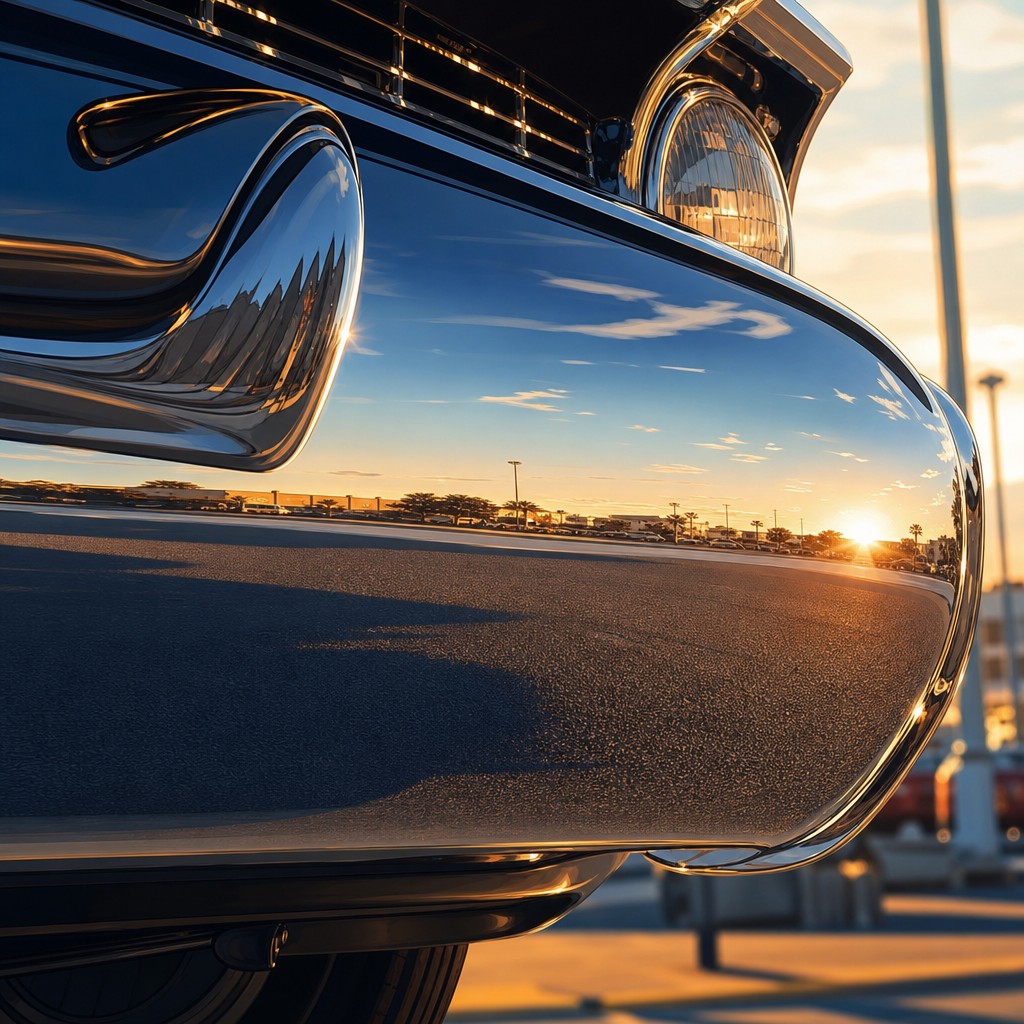
Chrome has no intrinsic colour; it is a relationship with its environment. Rendering it successfully requires defining three zones: the sky reflection band on top, the ground reflection band on bottom, and the razor-thin horizon line at the equator.
[RD-01.F01] — Macro detail: 1957 Chevrolet Bel Air front bumper. Sky gradient, sharp equatorial horizon, and warm asphalt ground bands define the perfect mirror-gloss finish.
1.2 Paint: The Decade You Are Reading. Automotive paint finish acts as a precise historical document, communicating an era before details are even parsed.
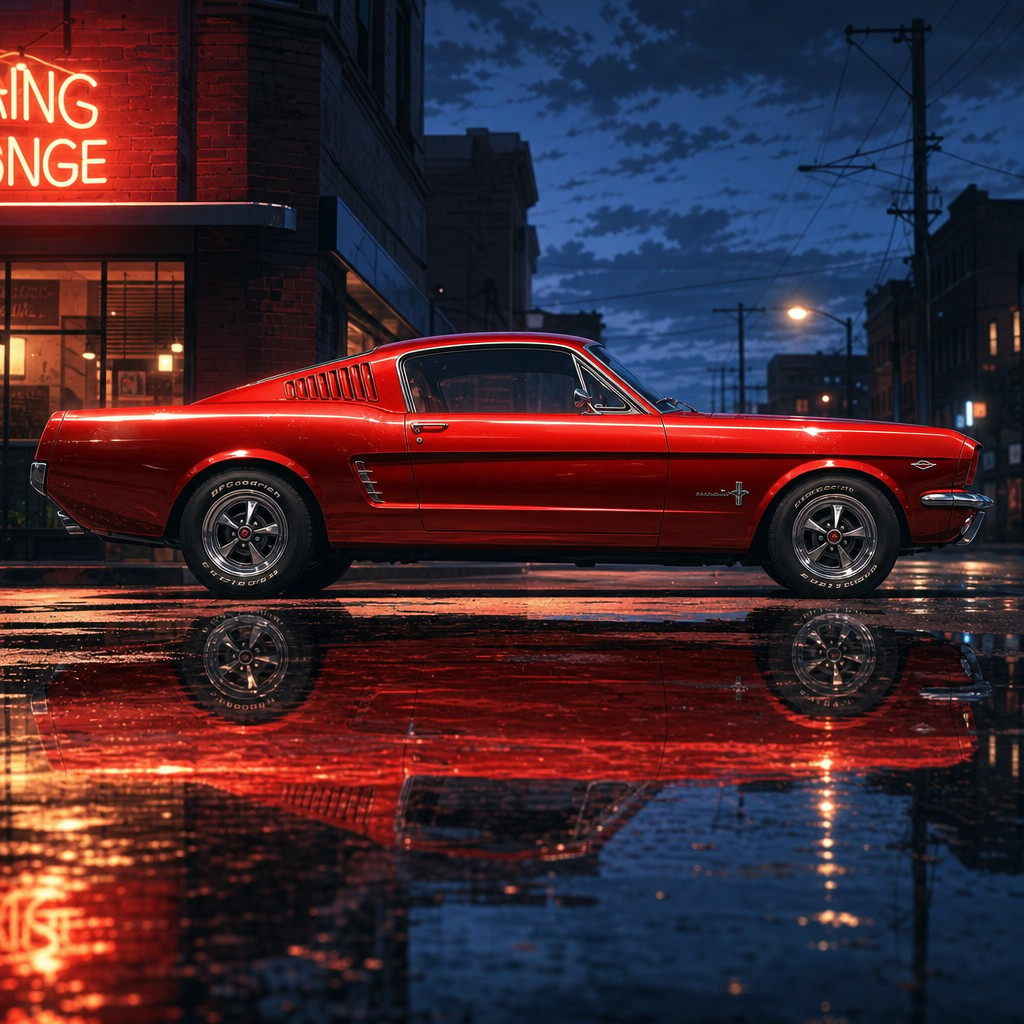
Era palettes: 1950s two-tone liquid lacquer; 1960s solid Racing Green or Rosso Corsa; 1970s earth tones and high-impact Hemi Orange; 1980s metallic silver, charcoal, and color-shifting pearlescents.
[RD-01.F02] — Profile view: 1966 Mustang Fastback in Candy Apple Red lacquer. Pure saturated red with deep, near-black shadows and sharp specular beltline highlights.
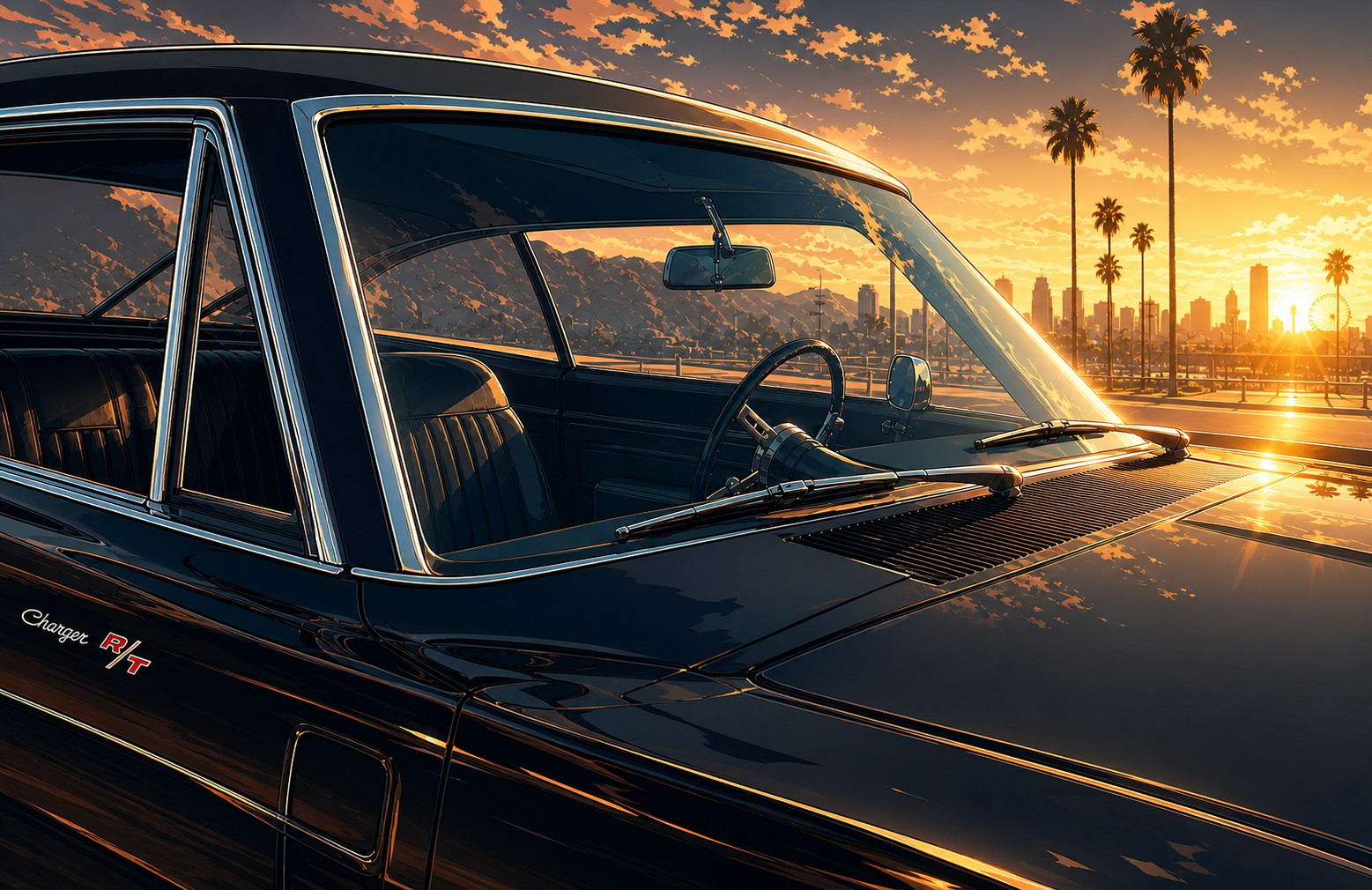
1.3 Glass: Translucent & Reflective. Windscreen rendering requires a dual-zone approach: sky reflections on the upper curves and interior elements visible through period-correct tinted glass below.
[RD-01.F03] — Medium close-up: 1969 Dodge Charger windscreen. 60 percent blue-tinted sky reflection, 40 percent interior panel details visible through historic green-cast glass.
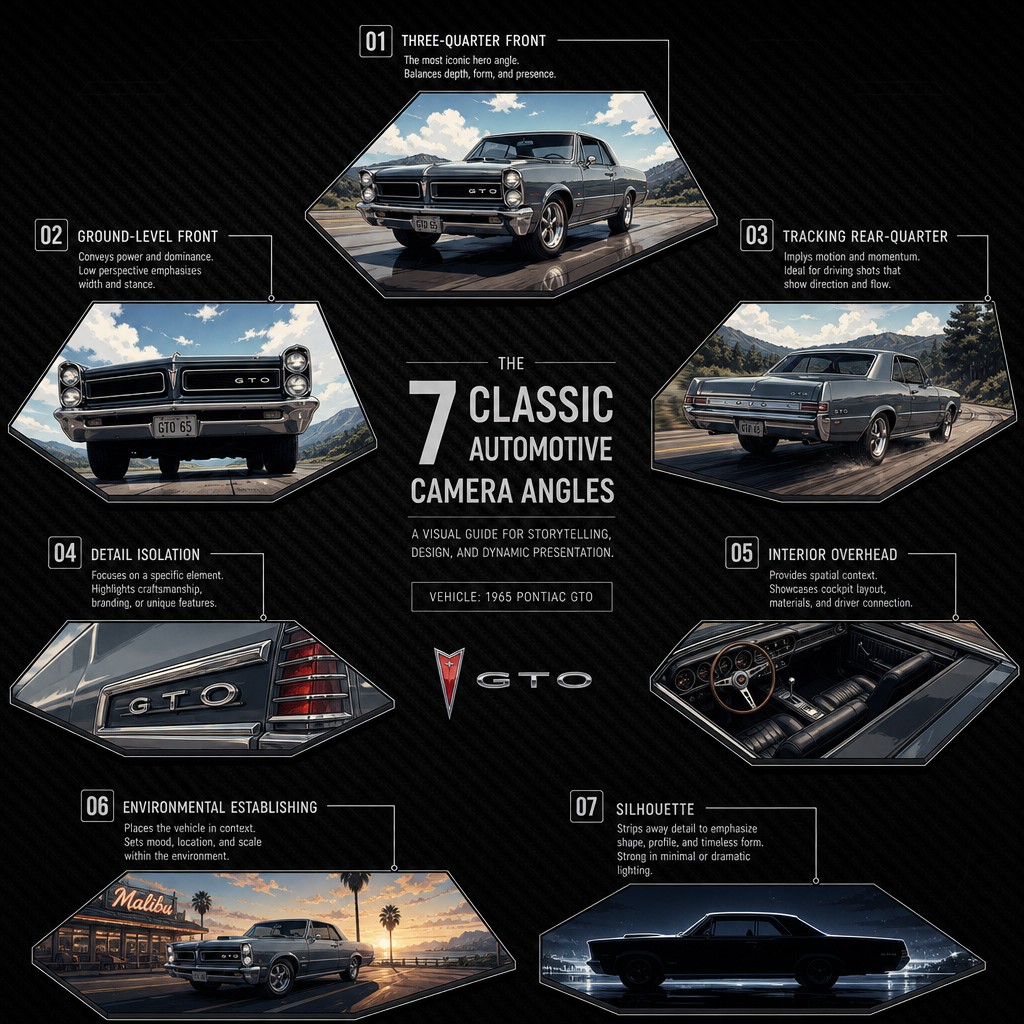
Chapter 2: Angle Architecture. 2.1 The Seven Classic Automotive Angles. Framing creates machine mythology. Professional photography relies on seven canonical views, each serving a specific emotional or commercial role.
Views include: Three-Quarter Front (commercial brochure), Ground-Level Front (dramatic architecture), Tracking Rear-Quarter (speed), Detail Isolation (materiality), Interior Overhead, Environmental Establishing, and Silhouette.
[RD-01.F04] — Composite diagram of seven core camera angles mapped onto a 1965 Pontiac GTO, showcasing the layout standard of classic automotive design media.
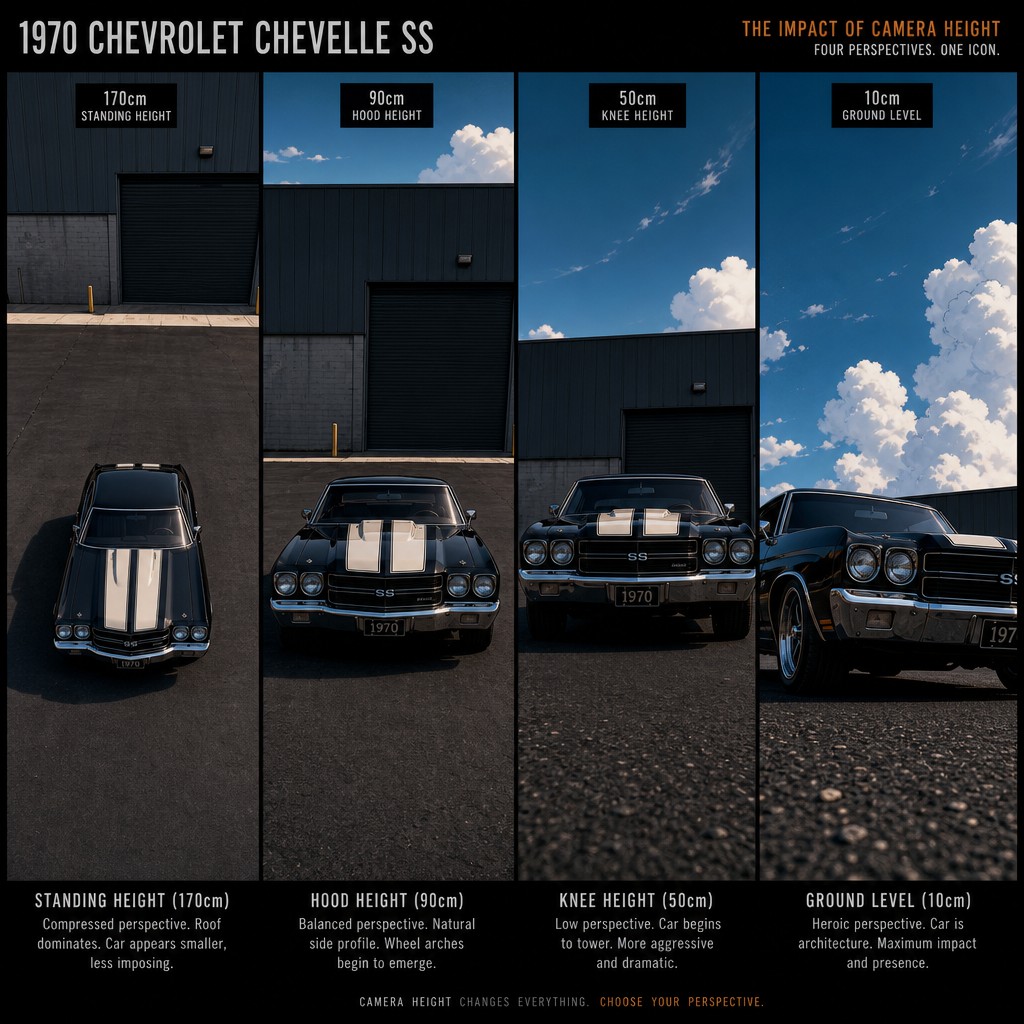
2.2 Low Angle Physics: Stance & Power. Dropping camera height is the single fastest upgrade to an automotive layout. It lowers the horizon, elevates the vehicle, and makes tyres dominant.
Camera heights: Standing height (looks down, roof dominant); Hood height (horizon at beltline); Knee height (car begins to tower); Ground level (the car reads as architecture).
[RD-01.F05] — Split-panel technical comparison: same 1970 Chevelle SS shot from standing height, hood height, knee height, and ultra-low ground level.
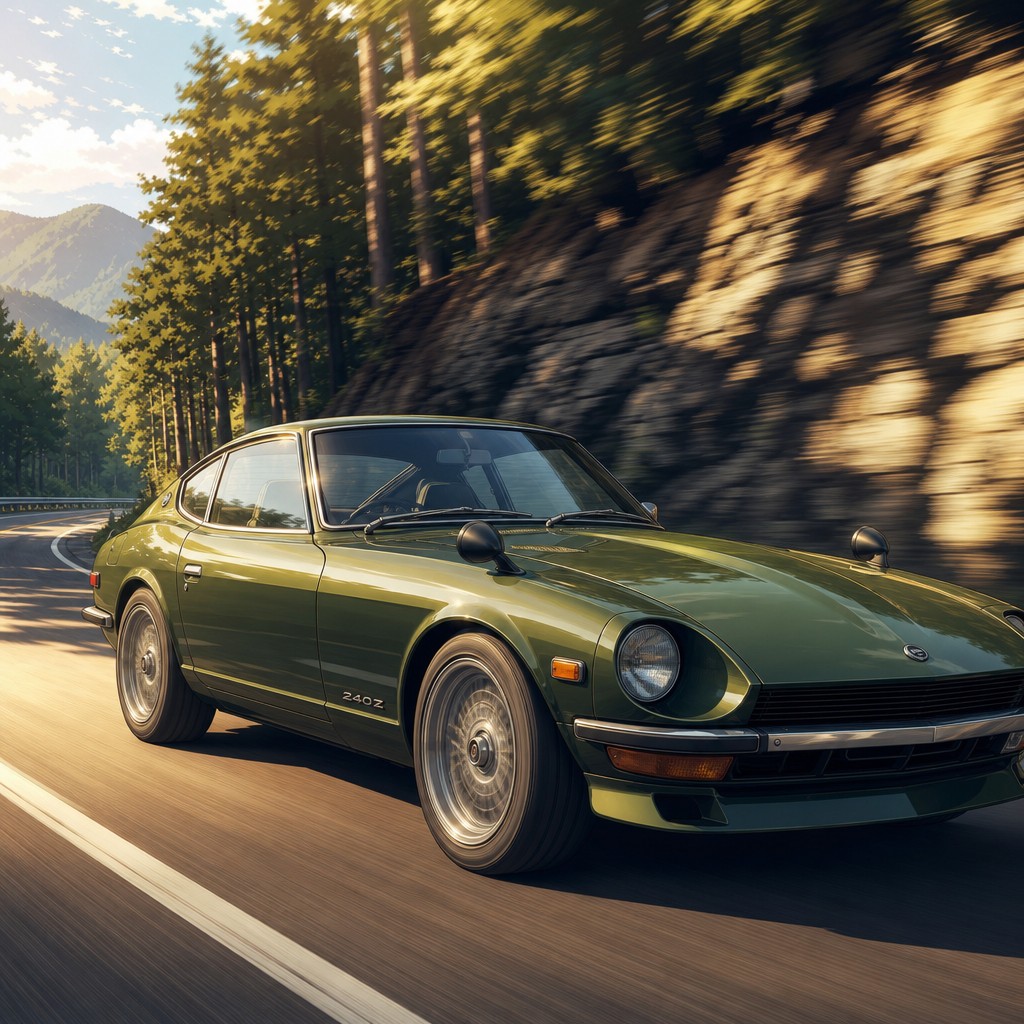
Chapter 3: Speed Effects. 3.1 The Visual Grammar of Motion. Speed is a constructed lie. Panning tracks the subject, blurring the background into parallel horizontal lines while keeping the body tack-sharp.
Motion codes: Radial blur defines spoke rotation; horizontal background blur communicates camera tracking; and frozen focus captures high action at the peak of structural drama.
[RD-01.F06] — Action shot: 1973 Datsun 240Z on mountain curves. Tracking shot speed panning, horizontal streak blur, and crisp radial wheel-rotation blur.
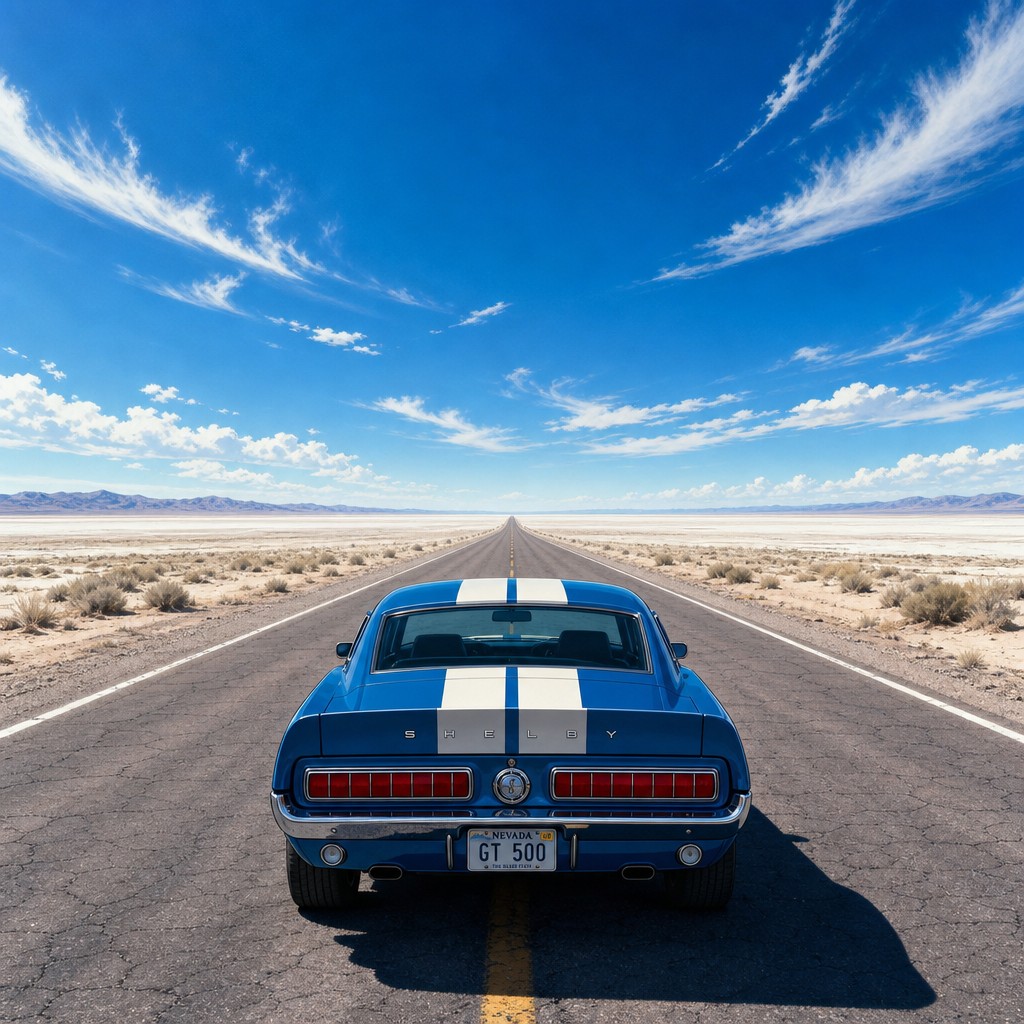
3.2 Environmental Speed Cues. Context carries speed. Vanishing-point highways, rubber on corner apexes, and active pitlanes imply velocity. Lighting choices select the mythological tone.
Time of day notes: Golden hour yields nostalgic cinema; post-sunset blue hour evokes urban secrecy; and high noon hard sun defines the rugged endurance of desert highway myth.
[RD-01.F07] — Wide view: 1968 Shelby GT500. Lower-center composition on straight Nevada highway. Bleached sky and tarmac vanishing into heat-shimmer horizon.
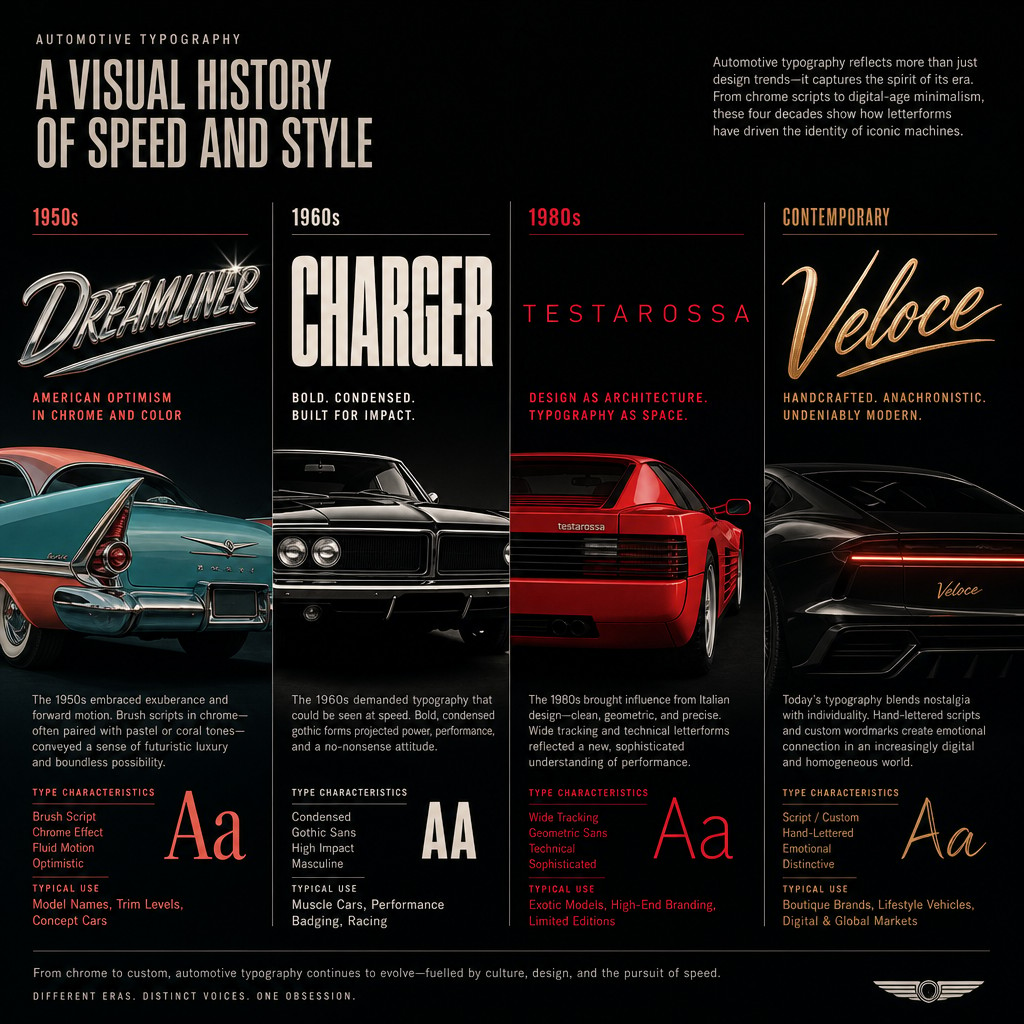
Chapter 4: Commercial Overlay. 4.1 Typography in Automotive Culture. Layout typography acts as a precise era stamp. Wrong typefaces break historical layout authenticity.
Era type: 1950s heavy brush scripts and slab serifs; 1960s-70s bold, blocky sans-serifs; 1980s thin, wide-spaced supercar branding; and contemporary resto-mod retro-revival scripts.
[RD-01.F08] — Typographic decade comparison: 1950s Dreamliner chrome script, 1960s Charger gothic sans-serif, 1980s Testarossa architecture, and gold Gold-on-Black modern script.
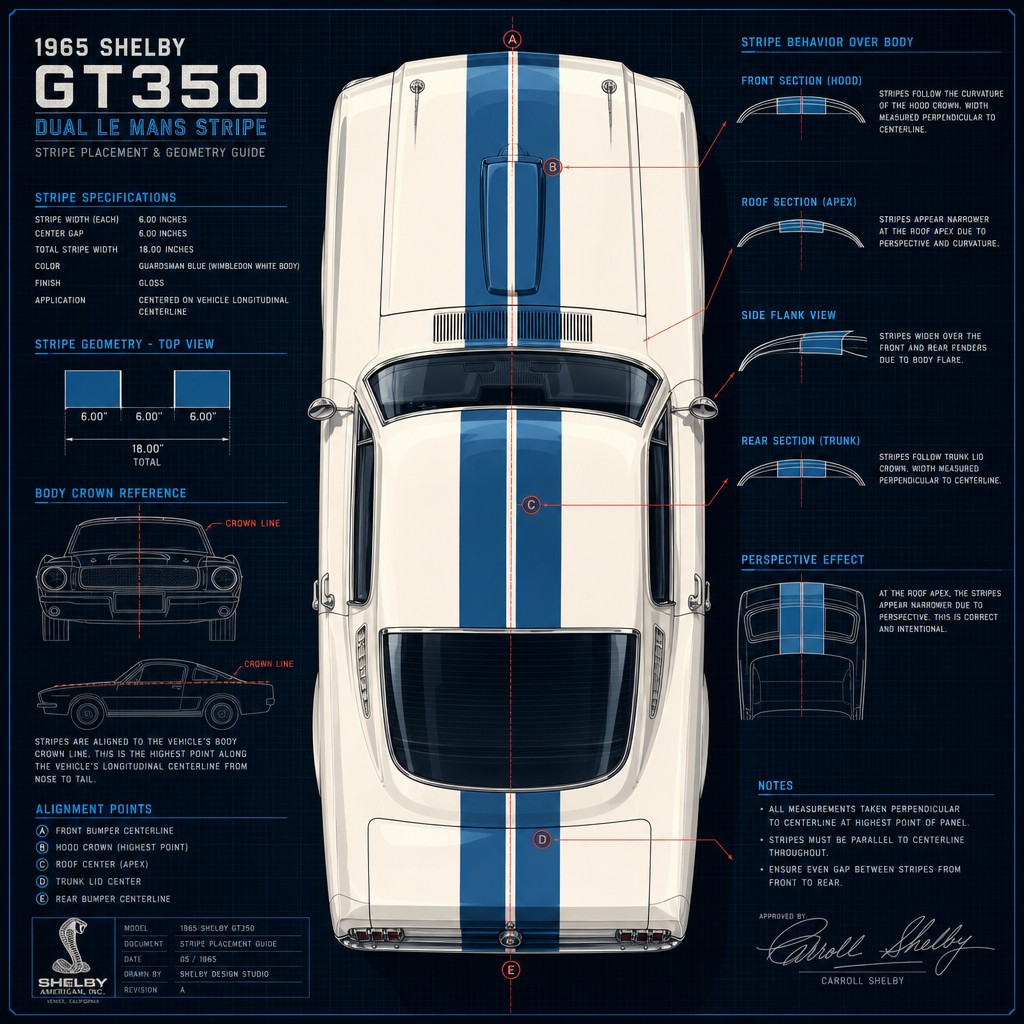
4.2 Racing Stripes: Geometry as Identity. Stripes are historical international team markers (American white, French blue, British green, Italian red) translated to road builds.
Placement physics: Stripes must track the absolute topographic center peak of the body (hood crown, roofline, trunk spine), naturally narrowing at the roof apex due to perspective.
[RD-01.F09] — Overhead blueprint: 1965 Shelby GT350. Dual Le Mans stripe centerline geometry with technical specification labels on dark blue-grid design background.
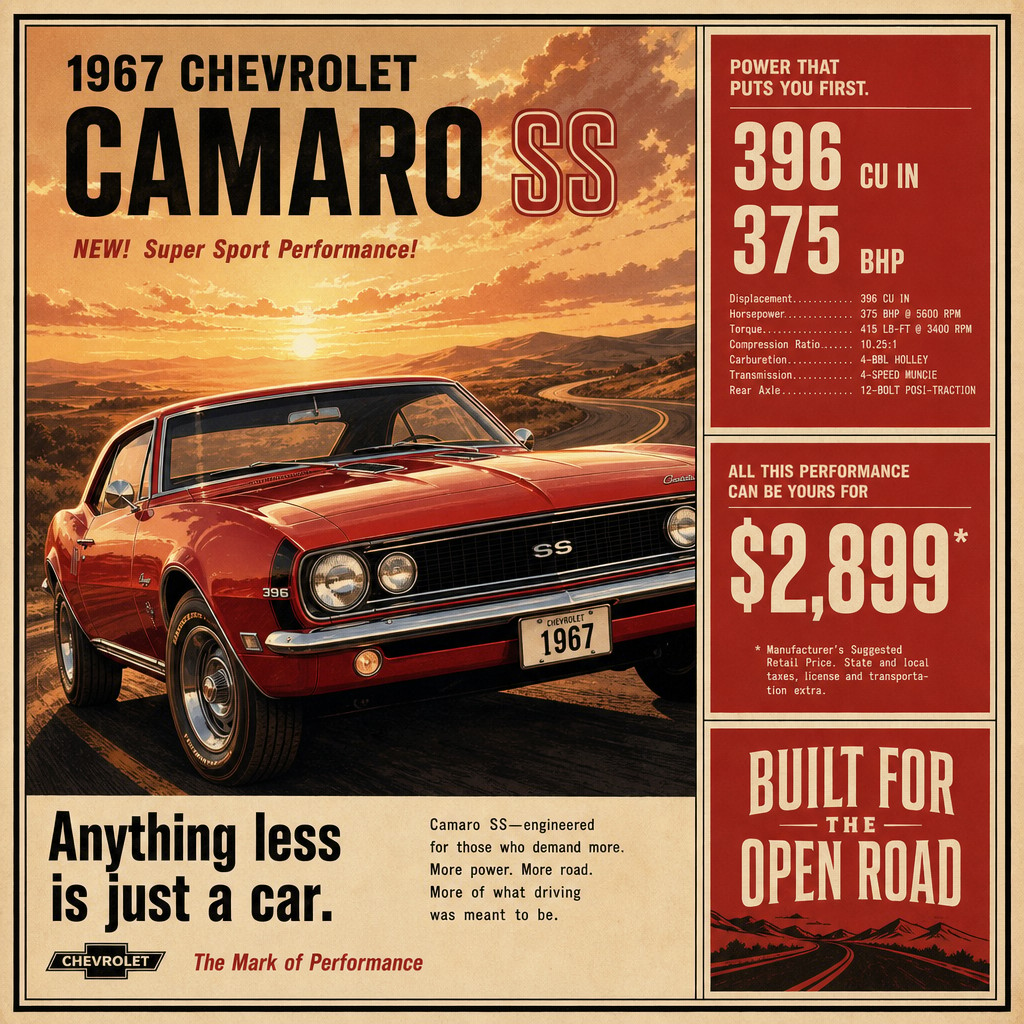
4.3 Feature Boxes & Callouts. The vintage feature box overlay acts as an active structural interrupt. It layers spec data, prices, or claims directly over the car imagery.
Anatomy standards: Thick outer borders, aligned tabular specifications, and primary colors pulled strictly from the car paint palette for deep cohesive integration.
[RD-01.F10] — Period advertisement: 1967 Chevrolet Camaro SS. Golden hour composition with offset specifications, price callouts, and heavy classic layout rule borders.
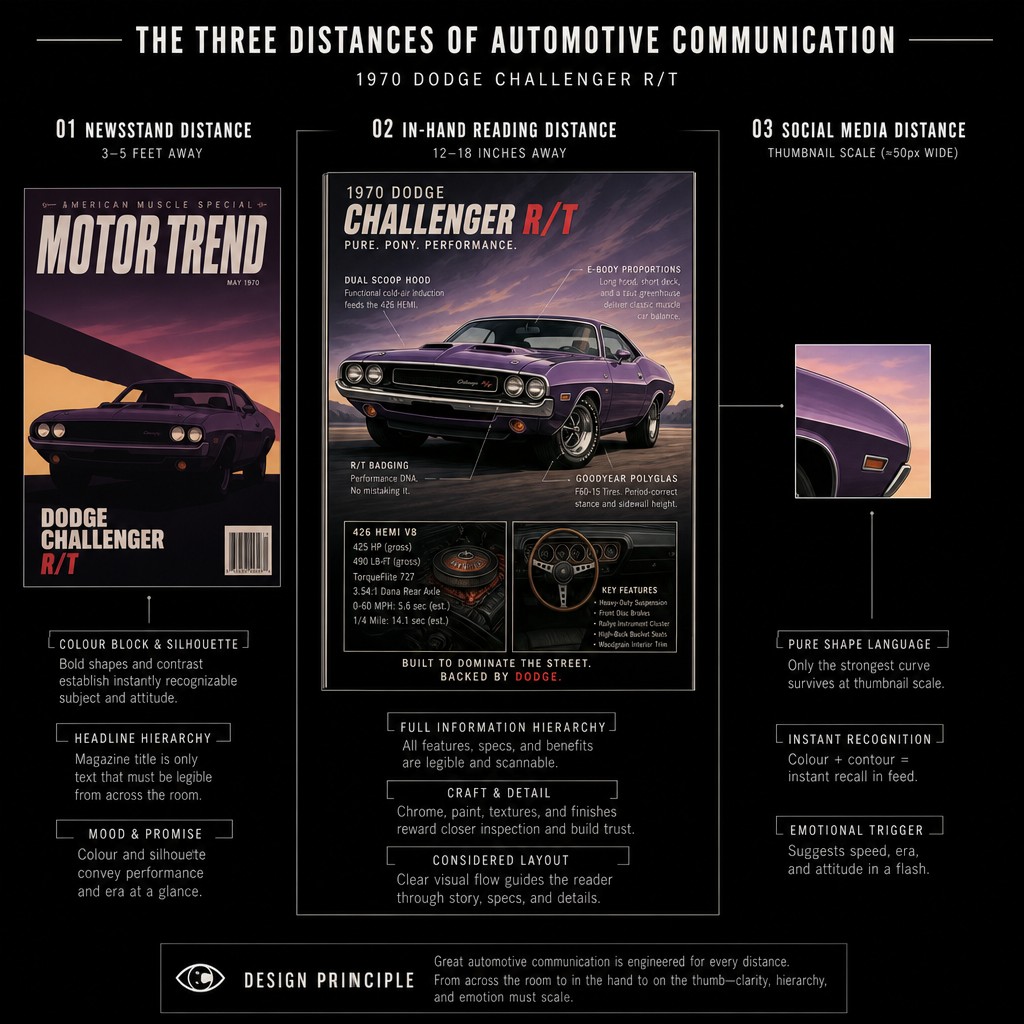
Chapter 5: The Cover. 5.1 Cover Composition. Magazine covers are visual arguments that must scale across three viewing distances: newsstand, in-hand, and digital thumbnail.
Scales: 2-meter newsstand scale requires dominant color blocks; 40cm reading distance checks chrome and print finish; 50px digital thumbnail evaluates pure iconic silhouette.
[RD-01.F11] — Three-scale overview: 1970 Dodge Challenger R/T cover mockups demonstrating newsstand impact, editorial reading, and digital thumbnail legibility.
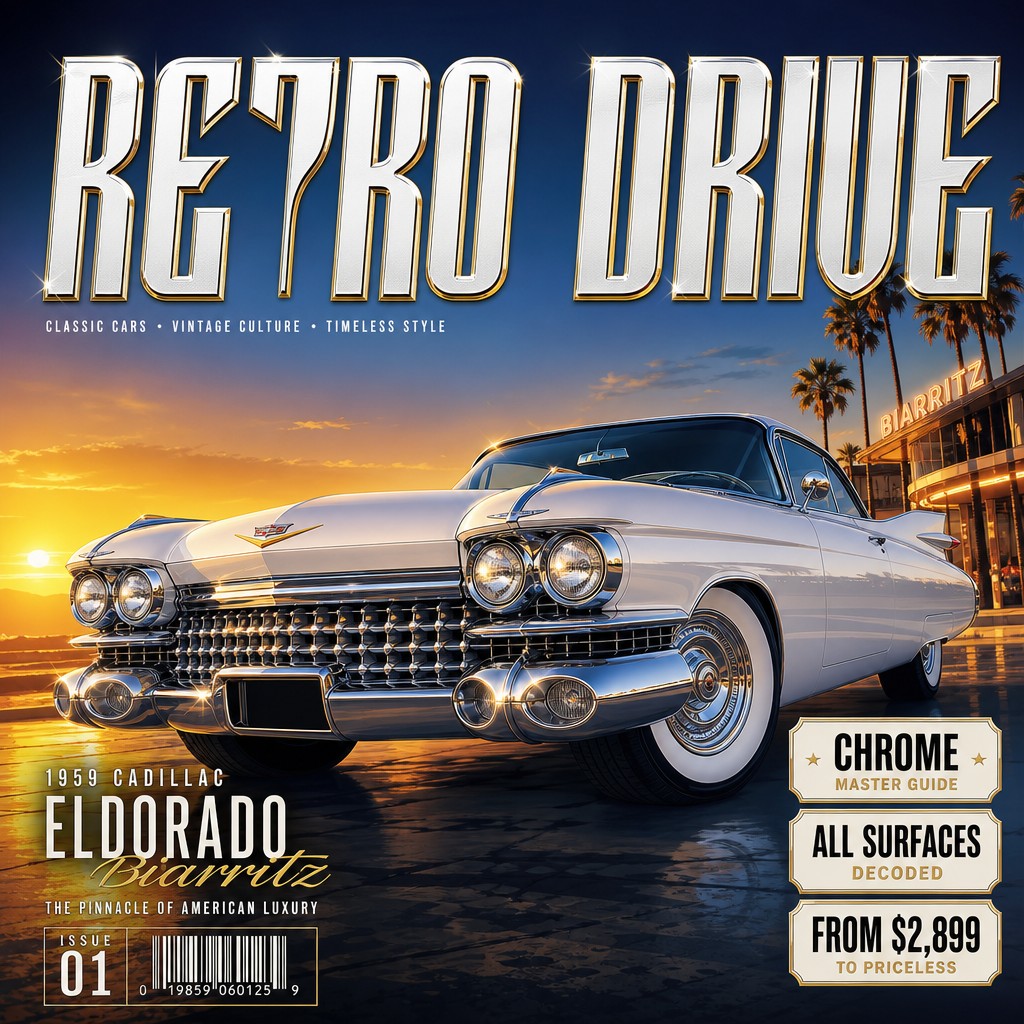
5.2 The Cover Formula. The optimal cover layout utilizes gradient sky backgrounds, low ground-level camera heights, and 45-degree cross-angled key lighting to grab details.
Key layout nodes: Title placed above the roofline; feature column stacked vertically along the right margins; and color accents unified with the hero vehicle body paint.
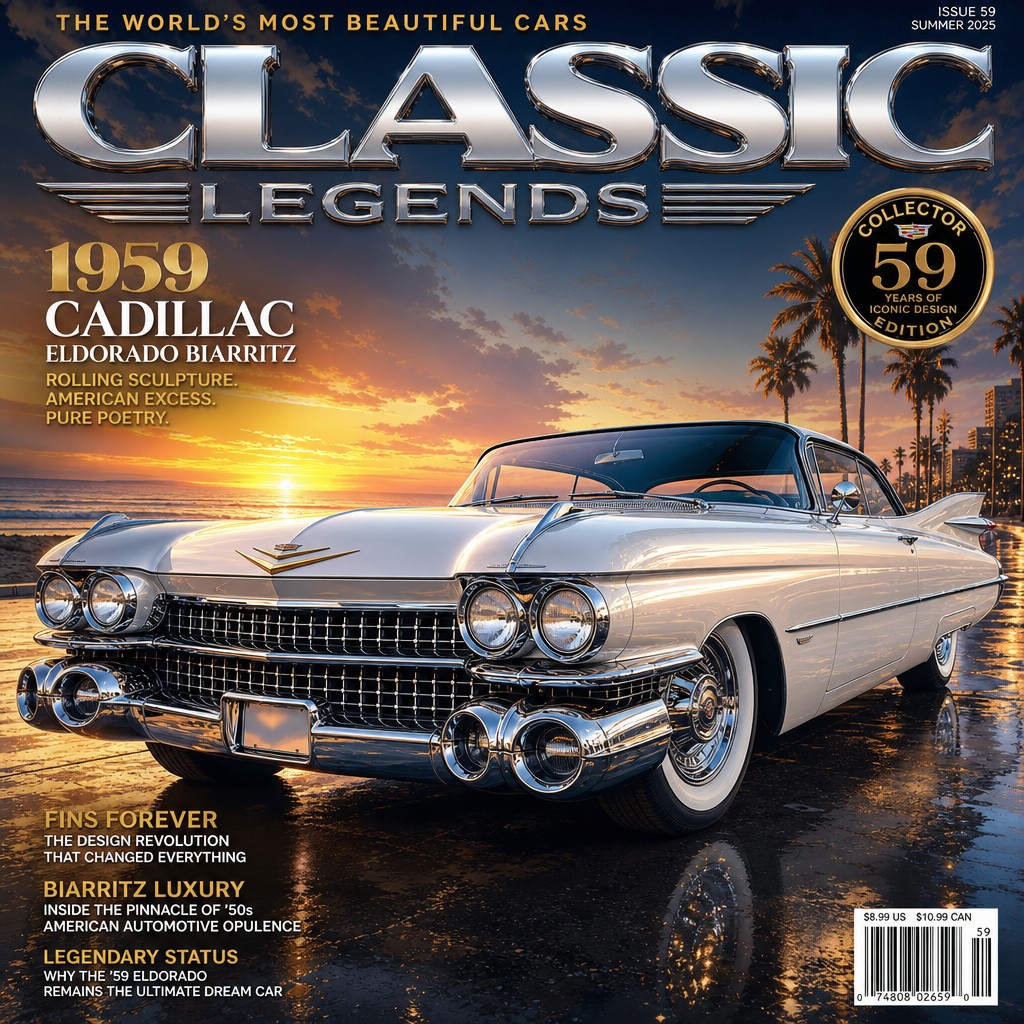
[RD-01.F12] — Complete cover design: 1959 Cadillac Eldorado Biarritz in pearl white, ground uptilt, golden gradient backdrop, retro chrome masthead, and spec feature blocks.
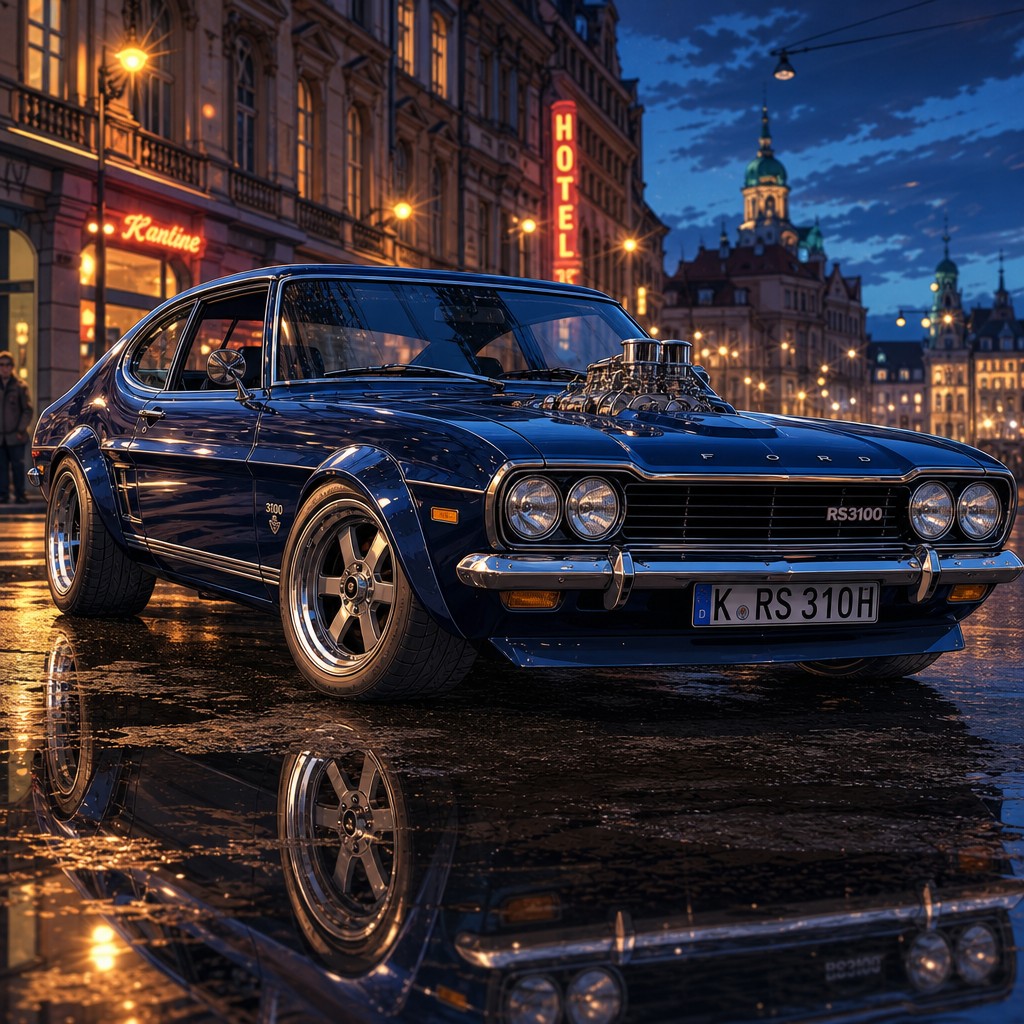
5.3 The European Counterpoint: 1973 Ford Capri RS3100. The Capri provides a compact muscular balance to American scale. [RD-01.F13] — Low angle: modified Ford Capri RS3100 on a rain-slick European city boulevard at blue hour. Production parameters: Hyper-realistic automotive photography, high-dynamic-range lighting, metallic, speed-culture vocabulary. RETRO DRIVE — Issue 01.
❦ FIN ❦